Discovering Green Sketching: Connecting with Nature through Art and Creativity
I'm really pleased to be able to announce that earlier this year I applied to Create Berwick for funding to support the development of some new workshops and I was awarded a grant! With thanks to Create Berwick's funders - the North East Combined Authority and Northumberland County Council.
My creative practice is fuelled by my love of the natural world, with much of my self-led illustration and design inspired by nature-based subjects. I really wanted to be able to support others to explore their creativity and help them to reconnect with nature to improve their wellbeing.
Thanks to this funding, I'm now a certified 'Green Sketching Ambassador' and I thought I'd just share a little about what exactly Green Sketching is and why everyone should give it a try.

My notes on The Green Sketching Handbook, Dr Ali Foxon.
What is Green Sketching?
Green Sketching is a toolkit developed by Dr Ali Foxon that helps people to see, enjoy and connect with nature’s beauty. In her book, The Green Sketching Handbook, Ali talks about our gradual disconnection from nature and the negative impacts that this has had for us as humans (physical, mental and emotional) as well as on biodiversity and the planet more broadly. She cites a range of scientific research that have proven the benefits of spending more time in nature, but also how these benefits can be amplified when we take the additional time to notice and record the world around us through the physical practice of sketching. In this era of rapid climate breakdown, the practice of Green Sketching can also bring more of us to care more deeply about the natural world and to take more steps in our everyday lives to reduce our carbon footprints.
Green Sketching is therefore an excellent mindful activity for nature enthusiasts but also for those who don’t think that they’re particularly interested in it, but who might be struggling with mental or physical ill health. It is also ideal for anyone who feels like they can’t draw, as the focus is on simple, observation-based sketching that supports a more mindful experience of nature.
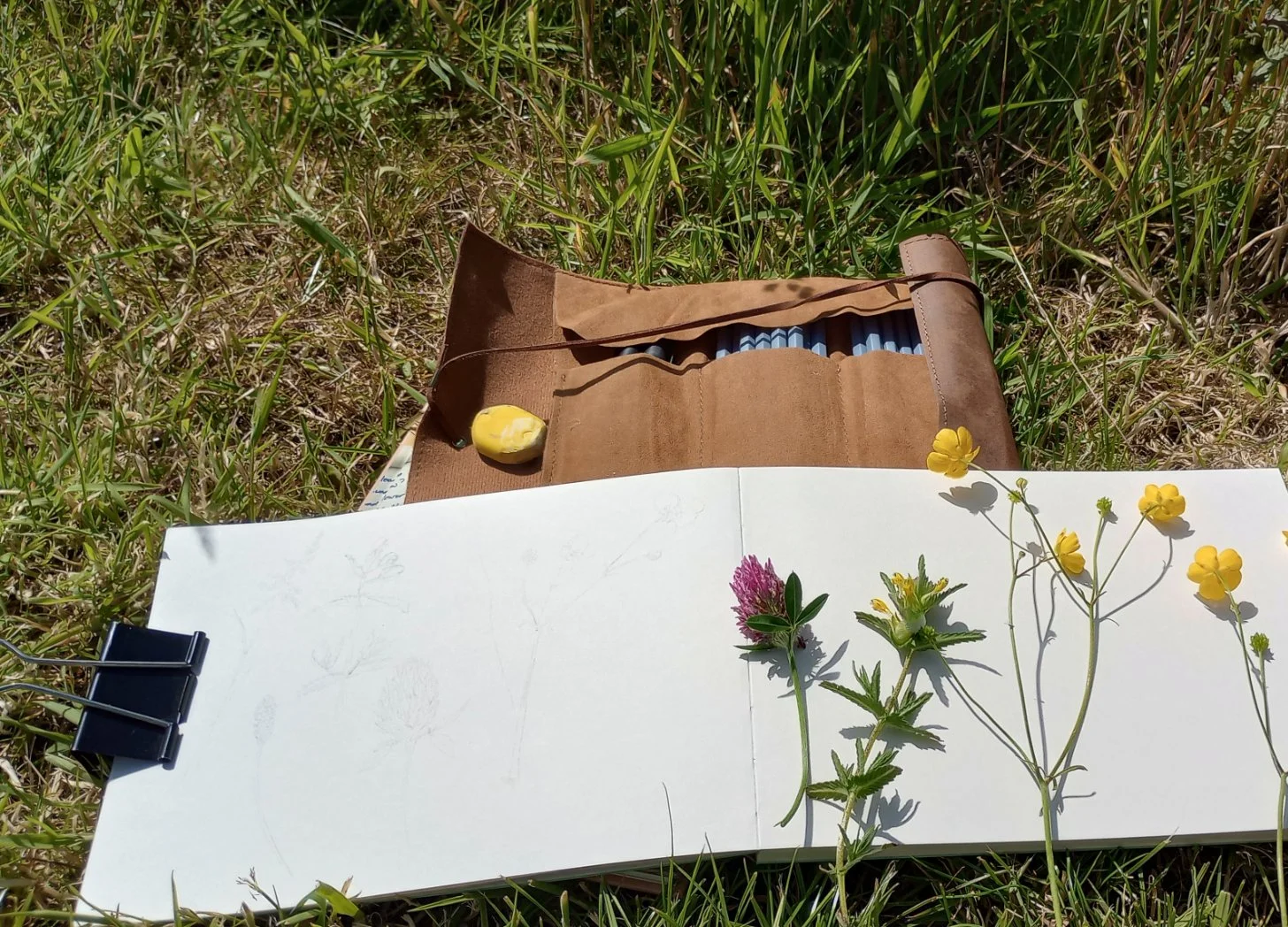
Sketching a variety of wildflowers growing in my back garden
The Benefits of Green Sketching
If you are already in the habit of regularly (or occasionally) spending time in nature, the chances are that you have a mobile phone camera roll that is full of snaps of things you’ve seen and that you want to remember. Ironically, using our phones to attempt to capture moments actually stops us enjoying them fully. By contrast, observational sketching - where we stop and look closely at a scene or object and then, in the process of drawing it, look at it again, and again - actually grounds us in the experience, making it more likely that we’ll remember the details and the emotions/thoughts that we felt/had at the time. The practice of Green Sketching actively encourages us to slow down and really observe the natural world around us, away from digital distractions.
There is also a growing body of evidence that shows that spending time in nature has a calming and relaxing influence on our minds and bodies. This can include:
strengthening our immune system and reducing the severity of things like respiratory-tract illnesses
accelerating healing
reducing symptoms of stress (reducing heart rate and cortisol levels)
reducing symptoms of anxiety and depression
improving our memory and concentration
supporting our body’s production of Vitamin D (and thereby reducing symptoms of Seasonal Affective Disorder)
But I can’t draw!
This is the most important bit, so I hope you’re paying attention - Green Sketching is about connecting more deeply and intentionally with the natural world, not technical perfection.
Sketching helps us to see details we might otherwise miss, as well as becoming more aware of our surroundings and the grounding sense of nature’s cycles. Although we’ve all become used to constantly curating content from our lives as part of our digital persona - and will doubtless have felt the pressure to only show the perfect moments - the practice of Green Sketching can be something that we keep completely to ourselves. It is the process of sketching that delivers all of the benefits and not the end result, so there’s no pressure to share your sketchbook with anyone else.
If you haven’t drawn since you were a child - or you have and were disappointed with the result - please be reassured that drawing is not a talent that people are born with. It is a skill that can be taught and learned. Once you’ve mastered the basics of observational drawing and basic mark making (which can be learnt in a simple, 2-hour workshop) then every time you take your sketchbook out to record something in the natural world, you’ll gradually find that sketching becomes more natural and enjoyable. You can sketch whatever you want to, in a way that feels right for you - embracing what your hand produces and developing your own way of expressing what you see. Experiment. Adapt. Play!
As an illustrator, I naturally share a lot of my sketchbooks and work-in-progress on social media and my website - but I have a ‘secret sketchbook’ for my own Green Sketching practice that so far I’ve not shared with anyone. It is very freeing to be able to create without fear of the ‘critical eye’, or with an end result or product in mind. I can be messy or structured, play with different materials that I wouldn’t normally use, and focus on tiny details without needing to consider context (ie can someone else tell what I’ve drawn here).



NB Neither of these sketches are from my ‘secret’ Green Sketching sketchbook!
Treading lightly on the planet
Green Sketching appeals to me as a practice because there it marries so well with my own values around looking after the environment. I encourage anyone interested in starting a Green Sketching practice to begin with minimal, eco-friendly materials - a sketchbook made from recycled, unbleached paper and a non-toxic pencil, or a refillable pen. I generally follow the principle of ‘observe, don’t disturb’ when I’m Green Sketching, although I will take inanimate objects like fallen leaves or the odd shell from the beach to study in more detail in the studio.

Eco-friendly art supplies and techniques
If you’d like some recommendations on being more eco-friendly with your art supplies, I wrote a blog post earlier this year on this very topic!
Getting Started with Green Sketching
Green Sketching doesn’t require a lot of time or supplies, you simply need to:
Pack simple materials: I recommend lightweight things like a small sketchbook, a pen or pencil and maybe some form of colour.
Pick a spot in nature: this could be your own garden or a nearby park - no need to go on a 10-mile hike! This is about making it as easy as possible for you to get outside.
Choose a subject: start with something small and simple, like a leaf.
Take your time: Slow down, breathe deeply and spend a minute or two just examining your leaf.
Get sketching:
Try a blind contour sketch where you look only at the leaf and not at your paper or your drawing hand. Try not to lift your pen from the paper and see what happens… doubtless your sketch won’t look remotely like the leaf, but you may be able to spot particular shapes or marks that you’ve recorded.
Hold your leaf on your paper and draw around it. Lift off your leaf and see if you can freehand record marks on the surface - spots, veins, blemishes, whatever you can see.
Can you ‘zoom in’ on a particular area of the leaf and record just the pattern or texture that you can see. Experiment with holding your pen in different ways (near the nib, at the barrel, upright to the page, at an angle) and see how this expands the range of marks you’re able to make.
How about some timed sketches? Assuming you have your phone (or a watch with a timer setting), set a timer for 30 seconds and draw your leaf as quickly as you can. Now extend your timer for 1 minute and draw the leaf again. And for 3 minutes and draw it again. What changed in each sketch and what remained the same? Is there a consistent element that you recorded each time, or something new you noticed when you had more time to look?
Find a new object and go through the exercises that you most enjoyed again. And repeat until you’re ready to stop/you run out of time/it gets dark!
Notice your thoughts and feelings throughout this exercise. Did you try to find the ‘perfect’ leaf to sketch? Why? If you did this, next time do you need to more consciously pick something ‘imperfect’ to sketch? Did any thoughts creep in as you were sketching, or did you find yourself lost in the task? How did you feel at the beginning of your Green Sketching session? Nervous, unsure, curious, excited, keen to get started? And how do you feel now at the end of your sketching session? Calmer, focused, relaxed, excited, pleased, cold(!)? (If the latter, learn to layer!)
Support for Your Green Sketching Journey
If you think you’d like some additional support in setting up your own Green Sketching practice, I'll be running a series of hands-on workshops on An Introduction to Green Sketching to help you discover nature through art and mindfulness here in beautiful Berwick-upon-Tweed, starting in Spring 2025.
These workshops will be for anyone looking for a new way to unwind and connect with our natural environment: no art skills required!
In 2 hours you'll learn how to:
use basic sketching techniques to record what you see in nature
cultivate mindfulness and presence through intentional observation
embrace creativity, let go of perfection and fully enjoy your time in nature
We'll start off at an indoor location to get to know our materials and practice some basic techniques, before heading off into a nearby green space to put some of what we've learnt into action. I'm hoping to be able to offer this 2-hour workshop - including basic sketching materials and a workbook for you to take away at the end of the day - for £35, but this is still subject to change at this point depending on space hire costs, etc.
If you'd be interested in finding out more and booking to attend a workshop, please check forthcoming dates on the Workshops page.