Eco-friendly art supplies and techniques
If you’re a regular reader, you’ll know that living sustainably is important to me. As a family, we put a lot of thought into where and how (and for what) we shop, we generate our own renewable energy and we choose public transport over owning a car. I try to take the same care and conscious thought into how I run my business, but also the supplies, tools and approaches I use in my illustration practice.
There are quite a few ‘easy wins’ that I’ve already made to try to ensure that the making of my art is having a minimal impact on the environment.
Sketchbooks
I am very lucky to live in Berwick-upon-Tweed which is also home to Pith Supply, a company that produces a range of sketchbooks, notebooks and planners that have minimal environmental impact - from the sourcing of materials to manufacture - which takes place in their small factory just across the River Tweed in Spittal. The factory itself is powered by renewable energy and they reuse or recycle all of their manufacturing waste.
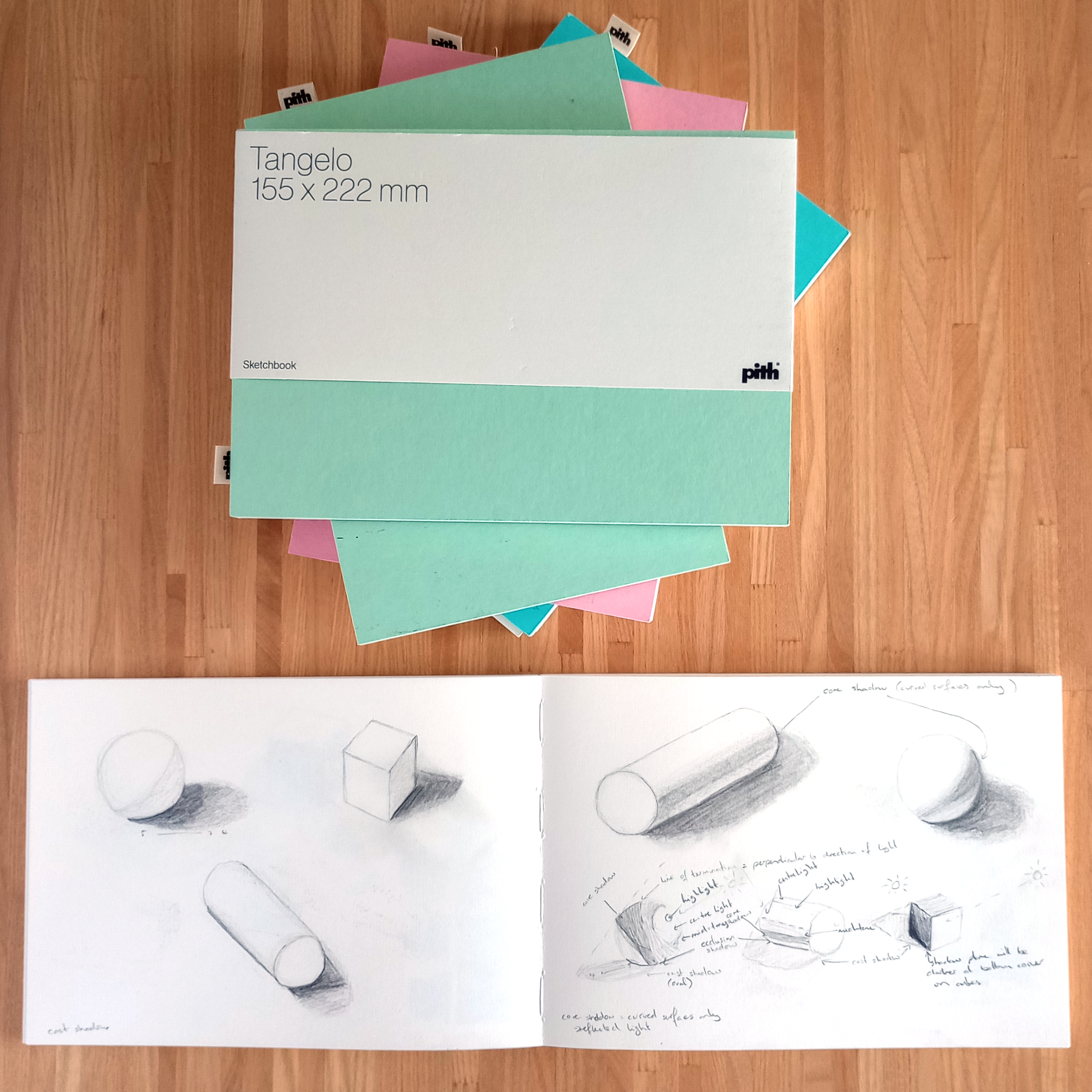
Pith Supply Sketchbook: The Tangelo
My absolute favourite sketchbook in their range is the Tangelo. It has 76 pages of off-white, acid-free 200gsm paper that is great for pencil, coloured pencils, charcoal, pastels, pen and ink drawing and light watercolour washes (particularly if you put masking tape around the edges to hold if flat whilst you work). The best feature is the exposed binding (hand-sewn and glued with water-based PVA) that allows the book to lay completely flat - perfect for working across a whole double-page spread. The sketchbook cover is made from coloured recycled board. I like to work in multiple sketchbooks at a time for different subjects/media - and the different coloured covers helps me to easily pick out the book I need.
Just a note that I am also addicted to the Pith Pomelo Planner - a slightly-bigger-than-A4-size planner/diary that addresses my need to make lists of tasks that I can tick-off every day.
Pens and pencils
I really love the process of drawing and my most-used tools are definitely pens and pencils. I primarily use Derwent wooden drawing pencils and graphite sticks in ‘black’, ‘hard’ and ‘firm’ weights for tonal drawing. As pencils are primarily wood and graphite, their environmental impact is relatively low.
Up until very recently, I’ve used Derwent or Faber-Castell fine line pens for ink drawing, as they come in a variety of line weights, are easy to find online and are relatively cheap. Of course, the downside to this is that they don’t really last very long and do run out of ink!
I’ve been starting to experiment with dip pens (which use a metal nib that can be replaced) and different types of ink, but for Christmas I received a Lumos pen from Tom’s Studio, which I’m super excited about!

Tom’s Studio: The Lumos
If you've not come across Tom's Studio, it is a Dorset-based business set-up by Tom after watching his calligrapher wife using plastic, mass-produced pens. Fortunately, Tom studied furniture and product design at uni and had experience working in a blacksmith's forge, so he set out to make a better pen that would last longer and be made from more environmentally-sound materials. He has gone on to develop not just calligraphy dip pens, but also fountain pens, a mechanical pencil and the Lumos, which is an infinitely refillable pen that can take six different types of fineliner tips, a brush tip, chisel and bullet. In short, it is amazing!
Watercolour paints
Whilst I love working in black ink, when I do choose to add colour my media of choice is primarily some form of watercolour. Watercolour paints have the least impact of the paint types available, as they don’t contain any petroleum-based pigment (often found in oil paint), polymer vehicles or binders (used in acrylic paints) and you don’t need any solvent-based products to clean your brushes as you can just rinse them in warm, soapy water. Some watercolour pigments do, however, contain heavy metals, which are toxic and increasingly pigments are made from synthetic materials, rather than natural ones. The main ‘waste’ caused by using watercolour is that you can’t recycle the paper even if it is made from wood pulp, rather than cotton, as the fibres have been altered by being wet. A more prosaic waste that I’ve noted is the need to be able to mop up and/or lift water and paint from the paper whilst working - for which most watercolour tutors recommend using kitchen towel. I tend to use a washable cloth for this, although it is important to use a microfibre cloth with a close weave if you don’t want to leave textured patterns in your paint!

Winsor & Newton: Professional Grade Watercolours
My go-to watercolour paints at the moment are the professional watercolour range from Winsor & Newton - there is some excellent and detailed information about the materials used in the production of this range available from the Design Life Cycle website, if you’d like to know more.
I also have a set of Kuretake Gambi Japanese watercolours, which are lovely and pigmented, but I don’t know much about their manufacture and obviously there are significant environmental impacts involved in shipping them around the world, so once I’ve used them up I won’t be replacing them.
Waste not, want not
With all that being said about watercolour being (relatively) better for the environment, I’ve always found it difficult to say ‘no’ to art supplies and so although I primarily work in watercolour and ink, I have a huge stockpile of all sorts of other media, which I really want to use up, rather than ‘saving’ them for when I feel more confident or having them generally go to waste! My intentions for this year are to therefore enjoy playing and experimenting with all of my art supplies on a regular basis, whilst recognising that - in the longer term - I’m likely to niche down to using fewer supplies that are made in an environmentally-friendly way.
Focus for 2024
In 2024, I’m going to be testing some small batch/handmade watercolour paint producers to see if I’d be happy to gradually move away from the bigger mass-produced brands that I use now.

Botanical inks and earth pigments
Last year I treated myself to some lovely handmade botanical inks from Bohemian Raspberry Art on Etsy - these inks are made from botanical sources and use environmentally-sound binders such as gum arabic and very little else. I really enjoyed working with them, so I’m also planning to experiment more with making my own botanical inks as well as maybe some earth pigments, using materials foraged or grown here in Northumberland - watch this space for updates on how this goes!