Creating designs that prompt environmental action: Bee-friendly Gardening
I’ve been working this week on a pattern for a competition run jointly by Blue Print Surface Design and Print Shows and Make It In Design (an online design school and creative community hub for surface designers). The aim of the competition is to raise awareness of the plight of bees as essential pollinators that are now close to extinction in many parts of the world.
The brief
The brief was to create a bee floral pattern design that reflects the ideal habitat of bees. This competition is ideal for me, as I love to illustrate simple steps that people can take to live a more environmentally-friendly and sustainable life and incorporate this into my illustration and surface pattern design.
A Toile de Jouy-style
I already felt confident that I wanted to create a Toile de Jouy-style pattern for my entry. Toile de Jouy is a sophisticated and decorative pattern design that first became popular in the late 18th century in France (hence the name). The pattern style used copper plates engraved with a pattern or design and rubbed with coloured inks before being transferred to fabric using a press. The engraving process allowed for the creation of fine lines, details, textures and even light and shade in printed fabrics and leant itself to the creation of narrative illustrations that often romanticised the countryside and rural life. Here are two examples of a classic Toile de Jouy pattern from British wallpaper companies, Graham & Brown and Little Greene.


I decided that I wanted to focus my design on illustrations that would highlight how people can support bees by making small changes in their gardens – no matter the size and space they have available.
First steps - research and artwork creation
First I did some research into different types of bee-friendly gardening and plants and zeroed in on three main scenes I wanted to include in my design:
1. A window box (for people with no outside space)
2. A container garden (for people with balconies or courtyard space)
3. A larger garden
In addition to these three main scenes, I decided to also include an illustration of a home-made bee hotel made from a re-purposed plastic bottle, to demonstrate a further step people can take to make bees and other pollinators welcome in their gardens.
I also made a list of ‘filler’ illustrations that I wanted to be able to scatter around my main scenes when creating the pattern. These included a range of types of bee on different flowers, as well as individual containers of bee-friendly plants and some other species that thrive in bee-friendly gardens.
I really enjoy making Toile de Jouy-style patterns as drawing detailed line work is my absolute happy place! However, it did take me almost a full week of sketching and inking before I had all of my elements ready.
My final illustrations included:
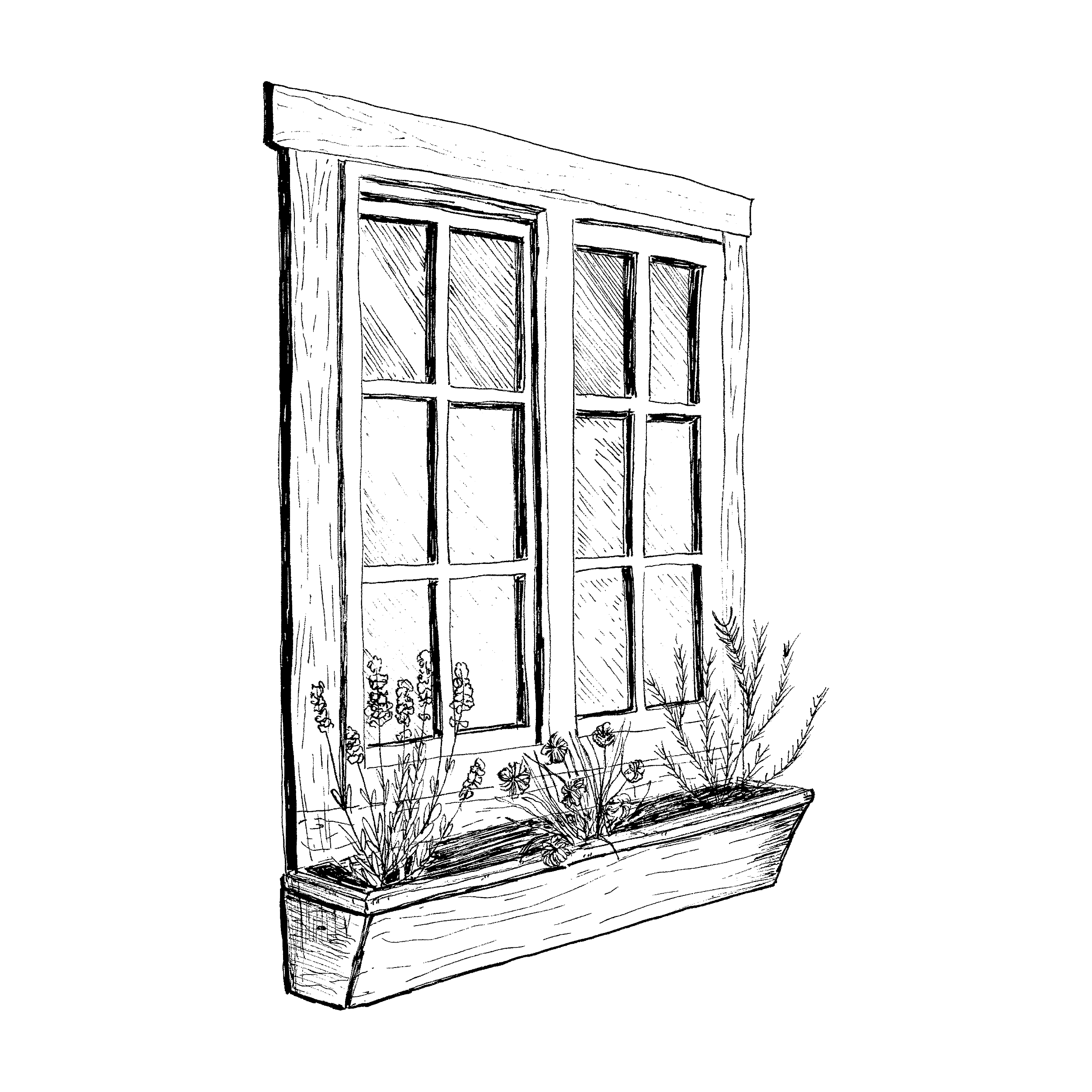
a window box planted up with rosemary, lavender and chives (all bee-friendly herbs)
a series of containers that could be in a courtyard, filled with bee-friendly flowers like budleia, honeysuckle, wildflowers, abelia and sage
a larger garden with a crab apple tree (bees love their blossom in springtime), ivy (nectar from the flowers supports bees over the winter) and a range of flowers and flowering shrubs, from sunflowers to hollyhocks and borage - a bee feast!
the home-made bee hotel, which uses a re-purposed plastic bottle and some garden bamboo (although you can also just fill them with twigs, grass and moss, or even paper straws)
and a host of bees and other pollinating insects (there's a ground beetle, a ladybird and a lacewing - see if you can spot them!)


Adding colour
The competition brief asked for entries to use a maximum of 8 colours. The pattern style I had chosen typically only uses two colours – but it is amazing how difficult it can be to choose between variations, even when you are only using two colours! For Toile de Jouy patterns, it is important to choose colours with a high contrast so that the detail remains crisp. The version I submitted used a Forest Green colour against a pale peach/pink background, to which I also added some texture.


That said, I’m rather fond of the two colourways I created that use a metallic gold – the Indigo on textured Gold and the Gold on textured Peach Melba.


And then I created a number of variations using two colours of the same or similar hue, but at different strengths (Forest on Mint, Indigo on Palest Blue and Gold on Textured Parchment).


What do you think? Do you have a favourite colour combination?
All of these variations will be available through my Print on Demand shops in due course - keep an eye out!